

Our Purchasing Policy
We implement CSR strategies in accordance with the following policy and guidelines to promote sustainable procurement.
Procurement Policy
Partnerships
We believe that building strong, cooperative partnerships with our suppliers is essential. These partnerships must be based on mutual trust and collaboration; to that end, we have implemented and published the "Declaration on Partnership Building" to foster long-term relationships.
https://www.biz-partnership.jp/declaration/120952-05-23-aichi.pdf

Open Procurement Practices and Confidentiality
We are committed to procuring materials and services in accordance with the principles of free competition, both domestically and internationally. We are committed to safeguarding and managing the confidentiality of information obtained through our procurement activities.
CSR Implementation
In recent years, corporate social responsibility (CSR) has gained significant attention. We are proactively implementing CSR initiatives and remain committed to strengthening our management foundation. We respectfully request the understanding and cooperation of our suppliers in supporting these efforts.
About Selecting Suppliers
When selecting suppliers, we consider a variety of factors, including quality, cost, delivery performance, financial stability, supply chain management, and development capabilities. We also assess each supplier’s adherence to social responsibility, which is one of the key criteria in our evaluations.
Green Procurement
In accordance with our "Environmental Policy," we have implemented an environmental management system to enhance internal audits, provide environmental education to employees, and proactively reduce our environmental impact. We also encourage our suppliers to obtain ISO 14001 certification and to cooperate with us on our green procurement initiatives. Our periodic supplier process audits assess whether their environmental criteria are met.
Purchasing Transaction Guidelines
What is the Purchasing Transaction Guidelines?
The Purchasing Transaction Guidelines specify the standards that all employees, including directors and officers, must consistently adhere to during their procurement activities and in their engagements with suppliers.
Key Principles
All purchasing transactions must comply with the guidelines on "Compliance with Corporate Ethics in Our Business Activities".
-
To foster good partnerships with our suppliers, we are expected to observe the following points:
- We are committed to treating all suppliers equitably, ensuring no favoritism toward any specific supplier.
- We stay up to date with all applicable laws and regulations, including the "Act Against Delay in Payment of Subcontract Proceeds, Etc. to Subcontractors," and adhere to standard business practices.
- We strictly maintain confidentiality of any information obtained from suppliers.
-
To select the most qualified suppliers and ensure healthy competition both domestically and internationally, we are expected to observe the following points:
- We respond in good faith to proposals from potential suppliers interested in partnering with us, and we share information about our products and transaction-related matters transparently.
- We conduct annual reviews of our current suppliers to develop future purchasing strategies.
-
Supplier selection procedures must be based on the Procurement Policy, as well as the following points:
- Requests for quotations are made only with a genuine intent to purchase.
- Internal procedures must be conducted in accordance with the separately prescribed "Purchasing Management Regulations."
Relationships with Suppliers
To uphold product quality, and maintain a resilient supply chain rooted in customer trust, we are committed to fostering sound, ethical business relationships with suppliers, in accordance with the Purchasing Transaction Guidelines outlined above.
Supplier Survey
We evaluate the development of a sound supply chain by administering written surveys to our suppliers. These surveys cover labor and management conditions, production facilities, suppliers, and quality policy. Final decisions on appointing new suppliers are made after audits conducted in collaboration with the Quality Assurance Department. Additionally, we request both new and existing suppliers submit a "Supplier Survey Sheet" annually and conduct regular reviews of all suppliers.
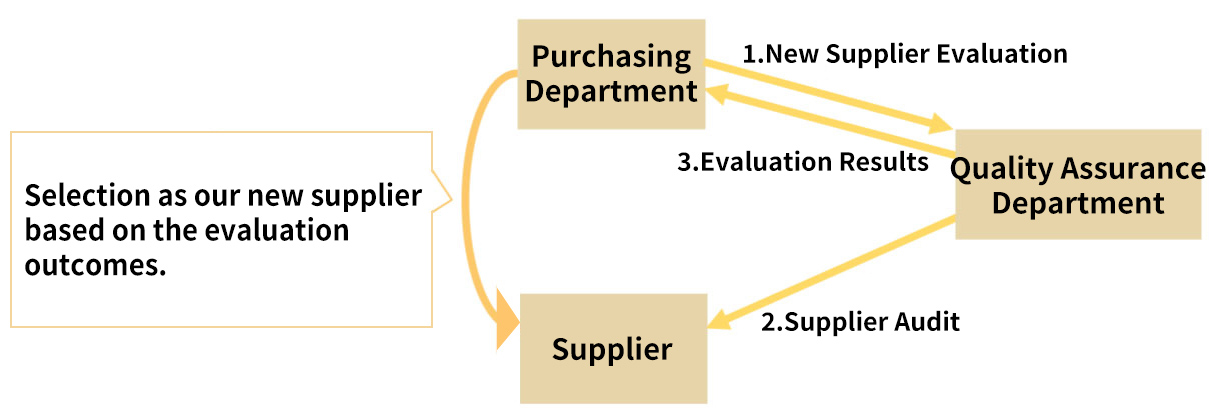
We conduct a "Green Procurement Survey" of our suppliers to evaluate their environmental management practices, including their implementation of environmental improvement initiatives, as well as their training and risk management efforts. In FY 2020, the Sakae Riken Group audited 62 out of 368 suppliers, approximately 17%. We remain committed to collaborating with our suppliers to promote CSR initiatives throughout the supply chain.


Certified Supplier
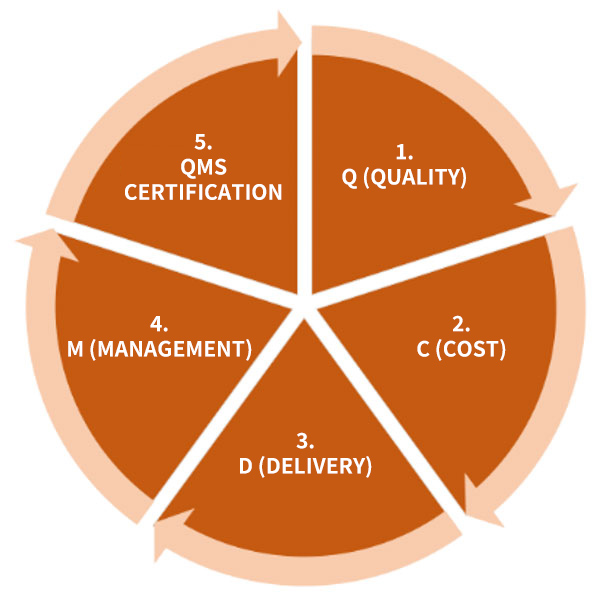
New suppliers are evaluated based on their total score for each item in the chart below. The outcome will determine whether they are registered as certified suppliers.
Existing suppliers are evaluated based on their total score on the "Supplier Survey Sheet" to determine whether their accreditation continues. In response to the evaluation results, we may request an "Improvement Plan" and provide guidance.
We conclude a basic transaction agreement and a "Request for Compliance with Substances of Concern (SOC) Regulations" with certified suppliers. If necessary, we also request a survey in accordance with the "Management Regulations for Environmentally Hazardous Substances."
Conflict Minerals Procurement
The use of minerals such as tantalum, tin, gold, and tungsten from conflict zones, which fund armed groups, poses risks of involvement in conflicts, legal violations, and human rights abuses. To avoid these risks, we have established the following Conflict Minerals Procurement Guidelines. As part of our efforts, we conduct an annual, supply chain-wide Conflict Minerals Survey, tracing back to the smelters, using the Responsible Minerals Initiative (RMI) Conflict Minerals Reporting Template (CMRT).
Conflict Minerals Procurement Guidelines
What are Conflict Minerals?
Conflict minerals refer to resources mined in conflict zones, particularly in the Democratic Republic of Congo and other African nations. Section 1502 of the Dodd-Frank Wall Street Reform and Consumer Protection Act (Dodd-Frank Act) identifies four regulated minerals: tantalum, tin, gold, and tungsten. As these minerals can fund armed groups linked to human rights abuses, identifying smelters is crucial to disrupting such activities.
Our Policy
Our policy prohibits the use of conflict minerals that could fund armed groups involved in conflicts in the Democratic Republic of Congo and neighboring regions. We require our suppliers to refrain from using conflict minerals from these regions. We also request supplier cooperation in our annual “Conflict Mineral Survey” to help trace and identify refiners.
SVHC Survey
A Substance of Very High Concern (SVHC) refers to substances listed as candidates for authorisation in Annex XIV of the REACH Regulation (EU Regulation on the Registration, Evaluation, Authorization and Restriction of Chemicals). Our SVHC survey covers all packaging and wrapping materials provided by our suppliers. For materials containing such substances, we explore potential alternatives and assess any challenges associated with their replacement. We promote initiatives to reduce reliance on these substances.

